# Services
> Source: https://docs.strapi.io/cms/backend-customization/services
Services store reusable functions to keep controllers concise and follow DRY principles. This documentation explains generating or extending services with `createCoreService` and organizing them for APIs or plugins.
Services are a set of reusable functions. They are particularly useful to respect the "don’t repeat yourself" (DRY) programming concept and to simplify [controllers](/cms/backend-customization/controllers.md) logic.
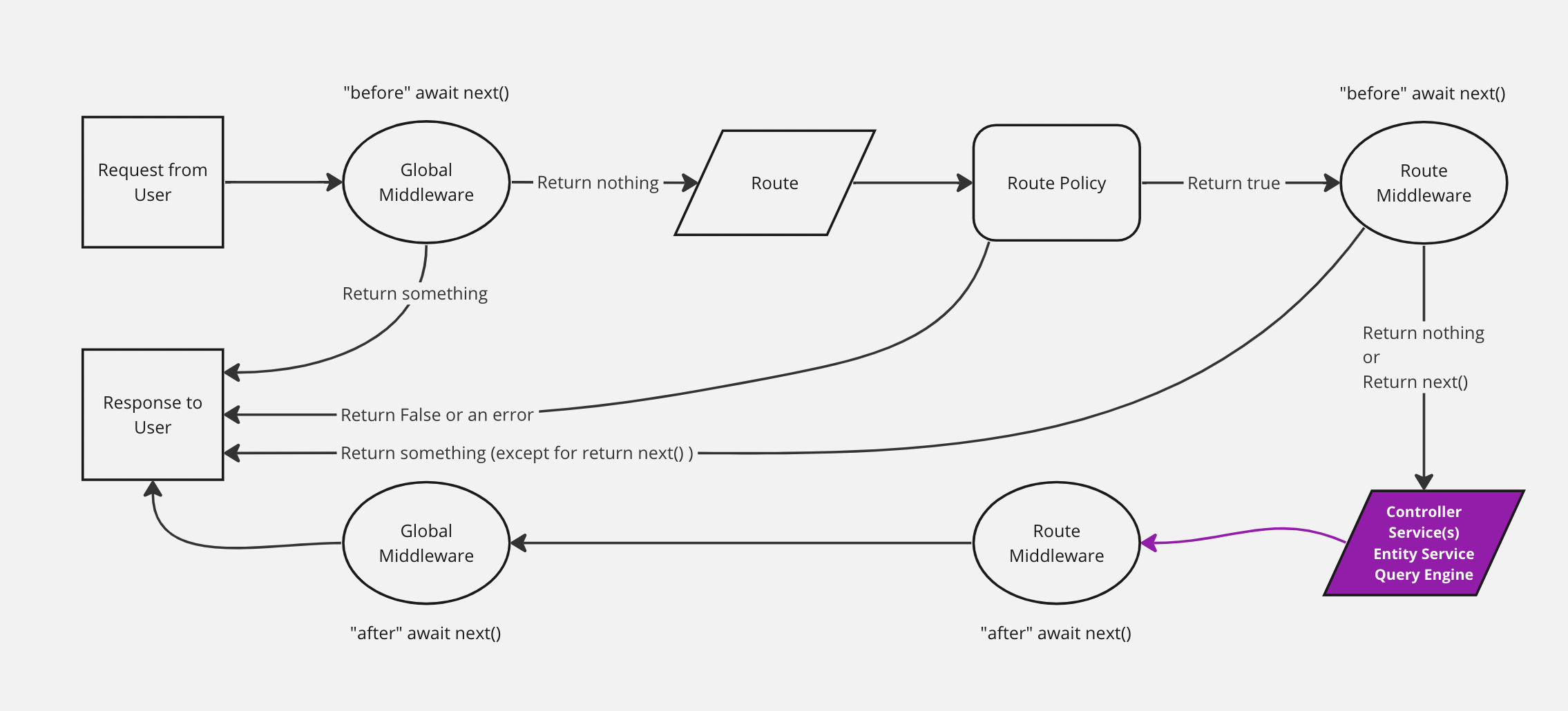
The diagram represents a simplified version of how a request travels through the Strapi back end, with services highlighted. The backend customization introduction page includes a complete, interactive diagram.
## Implementation
Services can be [generated or added manually](#adding-a-new-service). Strapi provides a `createCoreService` factory function that automatically generates core services and allows building custom ones or [extend or replace the generated services](#extending-core-services).
### Adding a new service
A new service can be implemented:
- with the [interactive CLI command `strapi generate`](/cms/cli#strapi-generate)
- or manually by creating a JavaScript file in the appropriate folder (see [project structure](/cms/project-structure.md)):
- `./src/api/[api-name]/services/` for API services
- or `./src/plugins/[plugin-name]/services/` for [plugin services](/cms/plugins-development/server-controllers-services).
To manually create a service, export a factory function that returns the service implementation (i.e. an object with methods). This factory function receives the `strapi` instance:
```js title="./src/api/restaurant/services/restaurant.js"
const { createCoreService } = require('@strapi/strapi').factories;
module.exports = createCoreService('api::restaurant.restaurant', ({ strapi }) => ({
// Method 1: Creating an entirely new custom service
async exampleService(...args) {
let response = { okay: true }
if (response.okay === false) {
return { response, error: true }
}
return response
},
// Method 2: Wrapping a core service (leaves core logic in place)
async find(...args) {
// Calling the default core controller
const { results, pagination } = await super.find(...args);
// some custom logic
results.forEach(result => {
result.counter = 1;
});
return { results, pagination };
},
// Method 3: Replacing a core service
async findOne(documentId, params = {}) {
return strapi.documents('api::restaurant.restaurant').findOne({
documentId,
// Use super to keep core fetch parameter formatting
...super.getFetchParams(params),
});
}
}));
```
```ts title="./src/api/restaurant/services/restaurant.ts"
// Method 1: Creating an entirely custom service
async exampleService(...args) {
let response = { okay: true }
if (response.okay === false) {
return { response, error: true }
}
return response
},
// Method 2: Wrapping a core service (leaves core logic in place)
async find(...args) {
// Calling the default core controller
const { results, pagination } = await super.find(...args);
// some custom logic
results.forEach(result => {
result.counter = 1;
});
return { results, pagination };
},
// Method 3: Replacing a core service
async findOne(documentId, params = {}) {
return strapi.documents('api::restaurant.restaurant').findOne({
documentId,
// Use super to keep core fetch parameter formatting
...super.getFetchParams(params) }) as any;
}
}));
```
:::strapi Document Service API
To get started creating your own services, see Strapi's built-in functions in the [Document Service API](/cms/api/document-service) documentation.
:::
Example of a custom email service (using Nodemailer)
The goal of a service is to store reusable functions. A `sendNewsletter` service could be useful to send emails from different functions in our codebase that have a specific purpose:
```js title="./src/api/restaurant/services/restaurant.js"
const { createCoreService } = require('@strapi/strapi').factories;
const nodemailer = require('nodemailer'); // Requires nodemailer to be installed (npm install nodemailer)
// Create reusable transporter object using SMTP transport.
const transporter = nodemailer.createTransport({
service: 'Gmail',
auth: {
user: 'user@gmail.com',
pass: 'password',
},
});
module.exports = createCoreService('api::restaurant.restaurant', ({ strapi }) => ({
sendNewsletter(from, to, subject, text) {
// Setup e-mail data.
const options = {
from,
to,
subject,
text,
};
// Return a promise of the function that sends the email.
return transporter.sendMail(options);
},
}));
```
```ts title="./src/api/restaurant/services/restaurant.ts"
const nodemailer = require('nodemailer'); // Requires nodemailer to be installed (npm install nodemailer)
// Create reusable transporter object using SMTP transport.
const transporter = nodemailer.createTransport({
service: 'Gmail',
auth: {
user: 'user@gmail.com',
pass: 'password',
},
});
sendNewsletter(from, to, subject, text) {
// Setup e-mail data.
const options = {
from,
to,
subject,
text,
};
// Return a promise of the function that sends the email.
return transporter.sendMail(options);
},
}));
```
The service is now available through the `strapi.service('api::restaurant.restaurant').sendNewsletter(...args)` global variable. It can be used in another part of the codebase, like in the following controller:
```js title="./src/api/restaurant/controllers/restaurant.js"
module.exports = createCoreController('api::restaurant.restaurant', ({ strapi }) => ({
// GET /hello
async signup(ctx) {
const { userData } = ctx.body;
// Store the new user in database.
const user = await strapi.service('plugin::users-permissions.user').add(userData);
// Send an email to validate his subscriptions.
strapi.service('api::restaurant.restaurant').sendNewsletter('welcome@mysite.com', user.email, 'Welcome', '...');
// Send response to the server.
ctx.send({
ok: true,
});
},
}));
```
```js title="./src/api/restaurant/controllers/restaurant.ts"
// GET /hello
async signup(ctx) {
const { userData } = ctx.body;
// Store the new user in database.
const user = await strapi.service('plugin::users-permissions.user').add(userData);
// Send an email to validate his subscriptions.
strapi.service('api::restaurant.restaurant').sendNewsletter('welcome@mysite.com', user.email, 'Welcome', '...');
// Send response to the server.
ctx.send({
ok: true,
});
},
}));
```
:::note
When a new [content-type](/cms/backend-customization/models.md#content-types) is created, Strapi builds a generic service with placeholder code, ready to be customized.
:::
### Extending core services
Core services are created for each content-type and could be used by [controllers](/cms/backend-customization/controllers.md) to execute reusable logic through a Strapi project. Core services can be customized to implement your own logic. The following code examples should help you get started.
:::tip
A core service can be replaced entirely by [creating a custom service](#adding-a-new-service) and naming it the same as the core service (e.g. `find`, `findOne`, `create`, `update`, or `delete`).
:::
Collection type examples
```js
async find(params) {
// some logic here
const { results, pagination } = await super.find(params);
// some more logic
return { results, pagination };
}
```
```js
async findOne(documentId, params) {
// some logic here
const result = await super.findOne(documentId, params);
// some more logic
return result;
}
```
```js
async create(params) {
// some logic here
const result = await super.create(params);
// some more logic
return result;
}
```
```js
async update(documentId, params) {
// some logic here
const result = await super.update(documentId, params);
// some more logic
return result;
}
```
```js
async delete(documentId, params) {
// some logic here
const result = await super.delete(documentId, params);
// some more logic
return result;
}
```
Single type examples
```js
async find(params) {
// some logic here
const document = await super.find(params);
// some more logic
return document;
}
```
```js
async createOrUpdate({ data, ...params }) {
// some logic here
const document = await super.createOrUpdate({ data, ...params });
// some more logic
return document;
}
```
```js
async delete(params) {
// some logic here
const document = await super.delete(params);
// some more logic
return document;
}
```
## Usage
Once a service is created, it's accessible from [controllers](/cms/backend-customization/controllers.md) or from other services:
```js
// access an API service
strapi.service('api::apiName.serviceName').FunctionName();
// access a plugin service
strapi.service('plugin::pluginName.serviceName').FunctionName();
```
In the syntax examples above, `serviceName` is the name of the service file for API services or the name used to export the service file to `services/index.js` for plugin services.
:::tip
To list all the available services, run `yarn strapi services:list`.
:::
### Core service methods
Services generated with `createCoreService` inherit methods that wrap the [Document Service API](/cms/api/document-service). The available methods depend on the content-type:
#### Collection types
| Method | Description |
| --- | --- |
| `find(params)` | Wrapper for [`findMany`](/cms/api/document-service#findmany); returns a paginated list of documents. |
| `findOne(documentId, params)` | Wrapper for [`findOne`](/cms/api/document-service#findone); returns a single document by its `documentId`. |
| `create(params)` | Wrapper for [`create`](/cms/api/document-service#create); creates a new document. |
| `update(documentId, params)` | Wrapper for [`update`](/cms/api/document-service#update); updates an existing document. |
| `delete(documentId, params)` | Wrapper for [`delete`](/cms/api/document-service#delete); removes a document. |
| `count(params)` | Wrapper for [`count`](/cms/api/document-service#count); returns the number of matching documents. |
| `publish(documentId, params)` | Wrapper for [`publish`](/cms/api/document-service#publish); publishes a draft document. |
| `unpublish(documentId, params)` | Wrapper for [`unpublish`](/cms/api/document-service#unpublish); unpublishes a document. |
| `discardDraft(documentId, params)` | Wrapper for [`discardDraft`](/cms/api/document-service#discarddraft); deletes the draft copy. |
#### Single types
| Method | Description |
| --- | --- |
| `find(params)` | Returns the single document (uses [`findFirst`](/cms/api/document-service#findfirst) internally). |
| `createOrUpdate({ data, ...params })` | Creates the document if it doesn't exist or updates it (uses [`update`](/cms/api/document-service#update)). |
| `delete(params)` | Deletes the document (uses [`delete`](/cms/api/document-service#delete)). |
| `count(params)` | Counts documents matching the filters (uses [`count`](/cms/api/document-service#count)). |
| `publish(params)` | Publishes a draft document (uses [`publish`](/cms/api/document-service#publish)). |
| `unpublish(params)` | Unpublishes the document (uses [`unpublish`](/cms/api/document-service#unpublish)). |
| `discardDraft(params)` | Deletes the draft copy (uses [`discardDraft`](/cms/api/document-service#discarddraft)). |
#### Parameters and default behavior
Core service methods accept the same parameters as their underlying [Document Service API](/cms/api/document-service) calls, such as `fields`, `filters`, `sort`, `pagination`, `populate`, `locale`, and `status`. When no `status` is provided, Strapi automatically sets `status: 'published'` so only published content is returned. To query draft documents, explicitly pass `status: 'draft'` or another value supported by the Document Service.
The `createCoreService` factory also exposes a `getFetchParams(params)` helper that converts a controller's query object into the parameter format expected by these methods. This helper can be reused when overriding core methods to forward sanitized parameters to `strapi.documents()`.